01
Encrypted ordinary silicon
Compatible CPUs and GPUs evaluate admitted operations over encrypted values and approved public operands. The worker never receives the customer secret key.
Run sensitive AI workloads across ordinary CPUs and GPUs without placing customer plaintext or decryption keys inside the infrastructure operator's domain. The customer keeps the authority. The fleet supplies the compute.
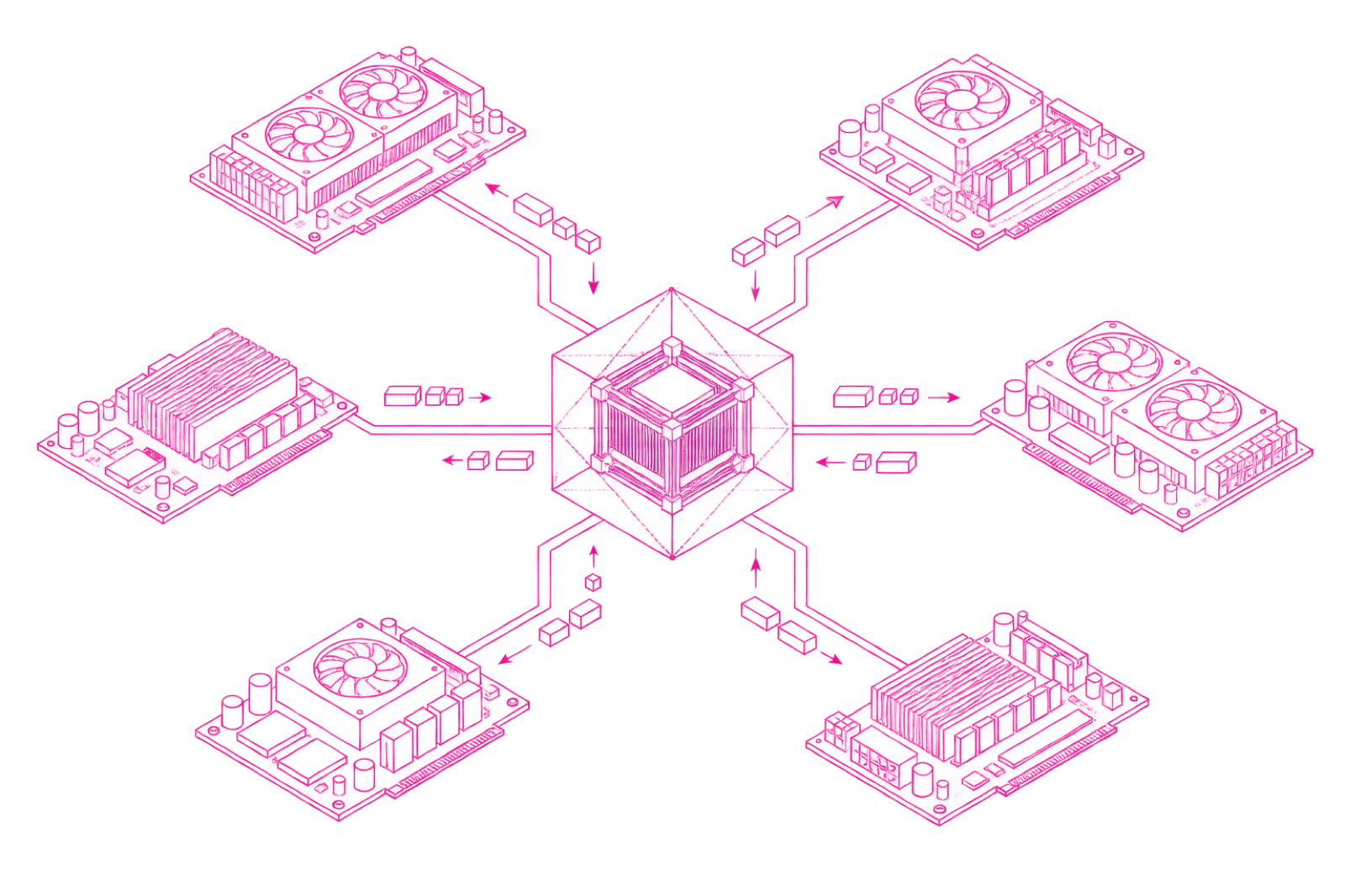
The nucleus remains inside the customer's accepted boundary. It handles secrets, private application state, verification and release. The swarm receives only the representation allowed by the selected execution profile.
SCSA admits the full application graph, identifies every private value and selects a route that covers the required operations. Unsupported private stages stay inside an accepted boundary or produce a defined refusal.
Compatible CPUs and GPUs evaluate admitted operations over encrypted values and approved public operands. The worker never receives the customer secret key.
Native private workloads run inside an accepted CPU or GPU boundary after fresh attestation and recipient key binding.
Protected shares move through independently administered participants under a declared corruption threshold.
A trusted nucleus can keep private state and release authority while an ordinary GPU swarm supplies eligible arithmetic.
The ordinary worker model assumes the operator can inspect memory and storage, replace software, retain traffic, replay messages or withhold service. Protected execution limits what that operator can learn. Verification decides whether its response can be accepted.
One computation. Two materially different views.
Holds plaintext, keys, private state, verification and accepted release.
The operator may inspect or alter the worker; verification determines whether its response is accepted.
Supplies eligible arithmetic over the admitted representation.
A model owner approves the model identity, permitted operation and output policy. The customer contributes a private prompt and context. The selected profile protects both assets and releases only the permitted answer.
Private inferenceActions, recipients, compute, data use and output allowances remain part of the job contract. Delegated authority can narrow through the workflow. The consequential endpoint checks the exact requested effect.
Authority modelBind the complete graph, numerical rules, protected assets and current permissions.
Place protected work only on resources eligible for the selected profile.
Verify the immutable response before secret-dependent acceptance.
Recheck authority and freshness, then commit the permitted result.
Classified material opens only on attested hardware, under t-of-n quorum, inside the window policy allows. There is no administrator who can override the math, and every access lands in a tamper-evident chain.
Explore →Trial datasets and molecular IP are sealed to approved lab hardware, with regulator-friendly attestations. Zero-knowledge proofs show the data is intact and untouched without exposing the dataset itself.
Explore →Sealed-bid auctions where no party, including the auctioneer, can peek early. Treasury approvals run as t-of-n quorums, and escrow opens at maturity because the time-lock says so.
Explore →Evidence is sealed at intake with hardware-derived signatures, so custody is provable rather than asserted. Time-locked escrow releases settlements, wills, and disclosures exactly when they should open.
Explore →Model weights decrypt directly into VRAM on attested GPUs and exist nowhere else in plaintext. Sealing binds to the die itself, so an exfiltrated checkpoint is useless off the approved hardware.
Explore →Every downstream anti-piracy tool — watermarking, fingerprinting, takedowns — starts work after a clean copy exists. SCSA operates upstream of the rip: content decrypts only inside the attested hardware of approved playback devices, so the clean copy that seeds every pirate network is never created at all.
Explore →